
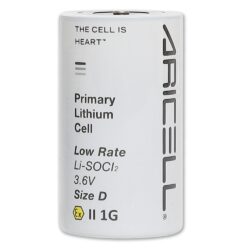
Custom Lithium-Thionyl Chloride Battery Pack
Cylindrical primary lithium cells are based on Lithium-Thionyl Chloride (Li-SOCl₂) chemistry. Li-SOCl₂ cells are best suited for applications that require high energy, high voltage, and operation across a wide temperature range.
Description
Specifications
| Battery Chemistry | Lithium-Thionyl Chloride (Li-SOCl₂) |
|---|---|
| Cell Construction | Bobbin and Spiral construction |
| Cell Housing | Hermetically sealed stainless steel can |
| Energy Density | Highest energy density among primary lithium chemistries |
| Operating Voltage | High operating voltage, stable through most of application lifetime |
| Self-Discharge Rate | Extremely low, suitable for long-term applications |
| Shelf / Operating Life | Long-term operation (5 to 20+ years depending on application) |
| Pulse Capability | Bobbin: low continuous current (µA base currents) with periodic pulses Spiral: pulse capability up to 4A |
| Temperature Range | Wide operating temperature range; models available for very high temperatures (oil & gas environments) |
| Magnetic Signature | Low magnetic signature |
| Manufacturing Process | Fully automated production in controlled environments for consistent quality and reliability |
| Typical Applications | Long-life industrial electronics, oil & gas equipment, remote monitoring, metering, defense, and harsh-environment systems |
| Product Overview | Lithium-Thionyl Chloride (LTC) cells are mass-produced in fully automated, controlled environments to ensure consistent quality and reliability. Available in bobbin and spiral constructions, these hermetically sealed stainless steel cells offer extremely high energy density and remarkably low self-discharge. Bobbin-type cells maximize active material loading for long-term, low-current applications with periodic pulses, while spiral construction cells support higher pulse currents up to 4A and operation at elevated temperatures. |
Reviews
There are no reviews yet.